Oscillations - CBSE Test Papers
CBSE Test Paper 01
Chapter 14 Oscillations
- The total mechanical energy of a harmonic oscillator 1
- Decreases linearly with time
- Increases linearly with time
- Is independent of time
- Increases quadratically with time
- A spring with spring constant k when stretched through 1 cm has a potential energy U. If it is stretched by 4 cm, the potential energy will become 1
- 16U
- 32U
- 4U
- 8U
- The length of a second’s pendulum decreases by 0.1percent, then the clock 1
- Gains 43.2 seconds per day
- Loses 37.8 seconds per day
- Loses 30 seconds per day
- Loses 13.5 seconds per day
- What is constant in simple harmonic motion? 1
- Potential energy
- Time period
- Kinetic motion
- Restoring force
- The angular velocities of three bodies in simple harmonic motion are, , with the respective amplitudes as If all the three bodies have same mass and velocity,then 1
- =
- =
- =
- =
- Give the name of three important characteristics of a SHM. 1
- What is the frequency of total energy of a particle in S.H.M.? 1
- Time period of a particle in S.H.M. depends on the force constant K and mass m of the particle . A simple pendulum for small angular displacement executes S.H.M approximately. Why then is the time period of a pendulum independent of the mass of the pendulum? 1
- A particle is executing S.H.M of amplitude 4cm and T = 4sec. find the time taken by it to move from positive extreme position to half of its amplitude? 2
- Show that for a particle executing S.H.M, velocity and displacement have a phase difference . 2
- A simple harmonic motion is represented by x = 12 sin (10t + 0.6) Find out the amplitude, angular frequency, frequency, time period and initial phase if displacement is measured in metre and time in seconds. 2
- Show that for a particle in linear SHM, the average kinetic energy over a period of oscillation equal to the average potential energy over the same period. 3
- A pipe 30.0 cm long is opened at both ends. Which harmonic mode of the pipe resonates with a 1.1 kHz source? Will resonance with the same source be observed, if one end of the pipe is closed? Take the speed of sound in air as 330 ms-1. 3
- A spring balance has a scale that reads from 0 to 50 kg. The length of the scale is 20 cm. A body suspended from this balance, when displaced and released, oscillates with a period of 0.6 s. What is the weight of the body? 3
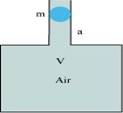
- An air chamber of volume V has a neck area of cross section a into which a ball of mass m just fits and can move up and down without any friction (Figure). Show that when the ball is pressed down a little and released, it executes SHM. Obtain an expression for the time period of oscillations assuming pressure-volume variations of air to be isothermal. 5
CBSE Test Paper 01
Chapter 14 Oscillations
Answer
Is independent of time
Explanation: The total mechanical energy is the sum of kinetic energy(KE) and potential energy(PE), is constant.
Here the figure depicts the energy of a linear harmonic oscillator vs displacement, horizontal axis represents the displacement x.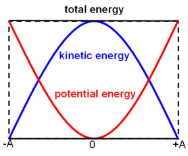
|From the graph it is clear that total energy is constant with displacement and the displacement is a function of time. So, total energy ( mechanical energy) is independent of time.
16U
Explanation: Potential energy of a spring is given by
thus for x = 4x
U become 16U
Loses 37.8 seconds per day
Explanation: Initial time period T= 1 s
T' = 0.9995T
In one day there are 75600 seconds
After reducing length new time will be 0.9995 × 75600=75562.2
Thus change is ∆T=75600-75562.2=37.8s
Thus clock losses 37.8 s per day
Time period
Explanation: The time period of the SHM is given by where 'm' be the mass of the body (constant) , 'k' restoring force constant as T depends on 'm' and 'k' and they are constant for the system, so the corresponding Time period of the motion is Constant.
=
Explanation: Max acceleration is given by
At highest dispacement x=A
for same mass and velocity
- Three important characteristics of an SHM are as follows.
- A restoring force must act on the body.
- Body must have an acceleration just opposite to the direction of displacement.
- The motion should be an oscillatory one.
The frequency of total energy of a particle in S.H.M is zero because it retains constant.
Restoring force in case of simple pendulum is given by
So force constant itself proportional to m as the value of k is substituted in the formula, m is cancelled out.If Y = displacement
t = time
a = amplitude
= Angular frequency
Now, Y = a cost
Given
So,
Now, T = Time Period,
Let WA is work done by spring A & kA = Spring Constant
WB is work done by spring B& kB = Spring Constant
WA : WB = 1 : 3Consider a SHM
Phase of displacement from (i) is
Phase of velocity from (ii) is
Hence, the phase difference .- Given equation of displacement, x =12 sin (10t + 0.6)
On comparing the above equation with the general eqeation of displacement, x(t) = A sin ()
We have,- Amplitude, A = 12 m
- Angular frequency, = 10 rad / s
- Frequency, = 1.59 Hz
- Time period, T = = 0.628 s
- Initial phase,= 0.6 rad
Suppose a particle of mass m executes SHM of time period T. The displacement of the particle at any instant t is given by the below general equation, y = A sint
Velocity of the particle, v =
Kinetic energy, EK =
and Potential energy, Ep =
Average KE of the particle executing SHM over a complete period of oscillation,
..........(i)
Now average PE of the particle executing SHM over a complete period of oscillation,
...........(ii)
So it is clearly seen from Eqs.(i) and (ii),Here, L = 30.0 cm =0.3 m
Let n-th harmonic of the open pipe resonates with 1.1 kHz source,
i.e. = 1.1 kHz = 1100 Hz
Again we know the formula of frequency of an open pipe for n-th harmonic, , v being speed of sound in air.
= 2
i.e. 2nd harmonic resonates with open pipe.
If one end of the pipe is closed, its fundamental frequency becomes [putting n = 0 in = (2n +1) ]
= 275 Hz
As odd harmonics alone are produced in a closed organ pipe, therefore, possible frequencies are 3 = 3 275 = 825 Hz, 5 = 5 275 =1375 Hz and so on. As the source frequency is given 1100 Hz, therefore, no resonance can occur when the pipe is closed at one end converting the open pipe as a closed one.Given
Maximum mass that the scale can read, M = 50 kg
Maximum displacement of the spring = Length of the scale, l = 20 cm = 0.2 m
Time period, T = 0.6 s
Maximum force exerted on the spring, F = Mg
Where, g = acceleration due to gravity = 9.8 m/s2
F = 50 9.8 = 490N
Spring constant,
Since, Mass m, is suspended from the balance.
Time period,
Weight of the body = mg = 22.369.8 = 219.167 N
Hence, the weight of the body is about 219 N.Given
Volume of the air chamber = V
Area of cross-section of the neck = a
Mass of the ball = m
The pressure inside the chamber is equal to the atmospheric pressure.
Let the ball be depressed by x units. As a result of this depression, there would be a decrease in the volume and an increase in the pressure inside the chamber.
Decrease in the volume of the air chamber, V = ax
Volumetric strain
Bulk Modulus of air,
In this case, stress is the increase in pressure. The negative sign indicates that pressure increases with a decrease in volume.
The restoring force acting on the ball, F = p a
In simple harmonic motion, the equation for restoring force is:
F = -kx … (ii)
Where k is the spring constant
Comparing equations (i) and (ii), we get:
Time period,


Comments
Post a Comment