Waves - CBSE Revision Notes
CBSE Class 11 PHYSICS
Revision Notes
CHAPTER 15
WAVES
- Transverse and longitudinal waves
- Displacement relation in a progressive wave
- The speed of a travelling wave
- The principle of superposition of waves
- Reflection of waves, Beats, Doppler effect
Angular wave number: It is phase change per unit distance.
i.e. ; S.I unit of k is radian per meter.
Relation between velocity, frequency and wavelength is given as :-
Velocity of Transverse wave:-
- In solid molecules having modulus of rigidity ‘n’ ’ and density ‘ρ’ is
- In string for mass per unit length ’m’ and tension ‘T’ is
Velocity of longitudinal wave:-
(i) in solid , Y= young’s modulus
(ii) in liquid , K=bulk modulus
(iii) in gases , K= bulk modulus
According to Newton’s formula: When sound travels in gas then changes take in the medium are isothermal in nature.
According to Laplace: When sound travels in gas then changes take place in medium are adiabatic in nature.
Factors effecting velocity of sound :-
(i) Pressure – No effect
(ii) Density
Temp-
(iii) Effect of humidity:– sound travels faster in moist air
(iv) Effect of wind –velocity of sound increasing along the direction
Wave equation if wave is travelling along +ve x-axis
- Y=A sin (ax - kx), Where,
If wave is travelling along –ve x- axis
Phase and phase difference
Phase is the argument of the sine or cosine function representing the wave.
Relation between phase difference ( and time interval is
Relation between phase difference and path difference is
Equation of stationary wave:-
(1) Stationary wave formed
(2) For (+ve) sign antinodes are at x= 0,
And nodes at x=
(3) For (-ve) sign antinodes are at x=
Nodes at x= 0,
(4) Distance between two successive nodes or antinodes are and that between nodes and nearest antinodes is
(5) Nodes- point of zero displacement-
Antinodes- point of maximum displacement-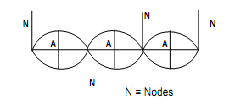
A = Antinodes
Mode of vibration of strings:-
M= mass per unit length
V= frequency, V=velocity of second , P=1, 2, 3, …..
b) When stretched string vibrates in P loops
c) For string of diameter D and density ρ
d) Law of length = constant


Comments
Post a Comment