Waves - CBSE Test Papers
CBSE Test Paper 01
Chapter 15 Waves
- The frequency of vibrating string is 200 Hz. If the tension is doubled, the frequency will be approximately 1
- 400.8 Hz
- 240.4 Hz
- 320.6 Hz
- 282.8 Hz
- Longitudinal waves cannot be propagated through 1
- a solid
- a gas
- a liquid
- vacuum
- A boat at anchor is rocked by waves whose crests are 100 cm apart and whose velocity is 25 cm/sec. These waves reach the boat once every 1
- 25 sec.
- 0.25 sec
- 15 sec
- 4 sec.
- If velocity of sound in air is 350 m/s then the fundamental frequency of a open pipe of length 50 cm is 1
- 700 Hz
- 500 Hz
- 350 Hz
- 175 Hz
- When sound travels from air to water the quantity that remains unchanged is 1
- speed
- wavelength
- frequency
- intensity
A steel wire 0.72 m long has a mass of 5.0 10-3 kg. If the wire is under r a tension of 60 N, what is the speed of transverse waves on the wire? 1
A hospital uses an ultrasonic scanner to locate tumours in a tissue. What is the wavelength of sound in the tissue in which the speed of sound is 1.7 km s-1? The operating frequency of the scanner is 4.2 MHz. 1
Define non dispersive medium. 1
A person deep inside water cannot hear sound waves produces in air. Why? 2
An organ pipe of length L open at both ends is found to vibrate in its first harmonic when sounded with a tuning fork of 480 Hz. What should be the length of a pipe closed at one end, so that it also vibrates in it’s first harmonic with same frequency? 2
A vibrating body with constant frequency sends waves 0.20 m long through the medium A and 0.25 m long through medium B. If velocity of waves in medium A is 280 ms-1, what is the velocity of the waves in medium B? 2
A source of frequency 250Hz produces sound waves of wavelength 1.32 m in a gas at STP. Calculate the change in the wavelength, when temperature of the gas is 40°C. 3
Two sitar strings A and B playing the note 'Ga' are slightly out of tune and produce beats of frequency 6 Hz. The tension in the string A is slightly reduced and the beat frequency is found to reduce to 3 Hz. If the original frequency of A is 324 Hz, what is the frequency of B? 3
The two individual wave functions are y1 = 5 sin (4x - t) cm and y2 = 5 sin (4x + t) cm where, x and y are in centimeters. Find out the maximum displacement of the motion at x = 2.0 cm. Also, find the positions of nodes and antinodes. 3
Prove analytically that in case of an open organ pipe of length /, the frequencies of the vibrating air nv column are given by = , where n is an integer having the values 1, 2, 3..... 5
CBSE Test Paper 01
Chapter 15 Waves
Answer
282.8 Hz
Explanation: According to the law of tension the frequency
f2 = 282.8 Hz
- vacuum
Explanation: Longitudinal waves are mechanical waves. They travel due to pressure diffrence created by waves in medium. In vacuum they cannot create pressure difference. Thus they cannot travel in vacuum.
- vacuum
4 sec.
Explanation: Here, velocity = 25 cm/s & wavelength = 100 cm
As velocity = frequency X wavelength
25 = frequency X 100 => frequency = 0.25
Hence time period = 1/frequency = 4 s
- 350 Hz
Explanation: Using relation for frquency of a standing wave in open organ pipe
for fundamental frequency n = 1. also convert length into meter
f = 350 Hz
- 350 Hz
frequency
Explanation: When a wave travel from one medium to another only the velocity and wavelength changes in such a way that its frequency remains constant.
Mass per unit length of the wire
= 6.9 10-3 kgm-1
Tension, T = 60 N
Speed of the transverse wave through the wire, v = = 93 ms-1Speed of sound in the tissue, v = 1.7 km/s =
Operating frequency of the scanner, V = 4.2 MHz =
The wavelength of sound in the tissue is given as:A medium in which speed of wave motion is independent of frequency of wave is called non-dispersive medium. For sound, air is non-dispersive medium.
Because speed of sound in water is roughly four times the sound in air, hence refractiveindex
For, refraction rmax = 900, imax=140. Since imax ≠ rmax hence, sounds get reflected in air only and person deep inside the water cannot hear the sound.As, the medium, frequency and a number of harmonic in open and closed pipes are the same, so a number of nodes and (wavelength), in both cases will be the same.
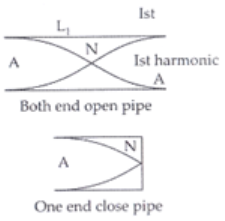
In case of both end open pipe, length of the pipe
and frequency
In case of one end open pipe, the length of the pipe
As medium and tuning fork in both cases are the same and (speed of sound in all mediums)
we get
So the length of one end closed pipe will be half of that of the both ends open pipe for resonance of the 1st harmonic with the same frequency.Here = 0.20 m and = 0.25 m, speed of sound in medium A, = 280 ms-1.
Let be the velocity of wave in medium B and be the constant frequency of vibrations.
Then,
= =
= = = 350 ms-1.Here we have, 0 = 250 Hz and T0 = 273K
Also, T1 = 273 + 40 = 313K; = 1.32 m
Therefore, Speed of sound = wavelength frequency, I.e, v0 = 0 = 250 1.32 = 330 m/s
Since we know that, Speed of sound, v
Thus we have,
= 330 = 353.34 m/s ............. (i)
and v1 = v0
= 1.41 m
Therfore, Change in the wavelength is given by:
= 1.41 - 1.32 = 0.09 mGiven:
Frequency of string A, fA = 324 Hz
Frequency of string B = fB
Beat's frequency, n = 6 Hz
Beat’s frequency is given as:
n = |fA fB|
6 = 324fB
fB = 330 HZ or 318 HZ
Frequency decreases with a decrease in the tension in a string. This is because frequency is directly proportional to the square root of tension. It is given as:
Hence, the beat frequency cannot be 330 Hz
fB = 318 HZGiven, y1 = 5 sin (4x -t) cm
y2 = 5 sin (4x + t) cm
We know that the resulting wave equation,
y = (2A sin kx) cos t
Now, comparing the given equation in the question with the above resulting wave equation we get,
y1 = 5 sin (4x-t) cm with y1 = A sin (kx - t).
A = 5 cm, k = 4 cm-1 and = 1 rad/s
Hence, y = (2A sin kx) cos t becomes
y =(10 sin 4x) cos t
The maximum displacement of the motion at position
x = 2.0 cm equals to
ymax =10 sin 4x, x = 2.0 and t = 0
= 10 sin (4 2) = 10 sin (8 rad)
ymax = 9.89 cm
The wavelength by using the relation between wavelength and wave number, we get
k = = 4
The nodes and antinodes can be given as
Nodes at x = = n cm,
where n = 0,1,2, ... any integer
Antinodes at x =(2n + 1)= (2n + 1) cm,
where n = 0,1,2,...any integer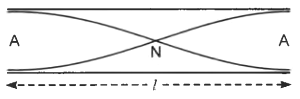
Consider an open organ pipe (open at both ends) of length . Let a longitudinal wave is moving from its left end to the right end and is given by:
y1(x,t) = A sin(kx - ) ................. (i)
When this wave reaches the right end, reflection takes place at the free end in which no phase change occurs. The reflected wave is given by:
y2(x,t) = A sin(kx - ) .................. (ii)
Two waves travelling in mutually opposite directions superimpose and the resultant displacement of any element is given by:
y(x, t) - y1 + y2 = A sin (kx - ) + A sin (kx + )
or y(x, t) = 2 A cos kx sin
It represents a standing wave whose amplitude is 2A cos kx.
The amplitude is maximum if cos kx = 1 or kx = 0 or n, where n = 1, 2......
Such points are called antinodes and the position of these points from either end of the pipe is given by:
x = = =
Obviously, from one end, positions of two ends are given by 0 and x = , hence, we have
l = or
Frequency of standing waves so setup will be given by
= = , where n = 1, 2, 3...........
Putting n = 1, 2, 3........, we can find the frequency of various harmonics as = , = , = .
Thus, it is clear that in an open organ pipe all harmonics are present.


Comments
Post a Comment